
Behind the Costumes, Pumpkins, and Walking Dead
Halloween is one of those holidays everyone thinks they already understand. Pumpkins. Costumes. Candy. A vague sense that it used to be something darker and more Celtic. Most of us leave it at that.
But dig a little and the story gets stranger, messier, and far more interesting. Halloween is not a pure pagan survival, nor is it simply a Christian feast with a spooky coat of paint. It is a hybrid that has been reinvented several times over, carrying pieces of seasonal ritual, Christian remembrance of the dead, Irish and Scottish folk custom, immigrant adaptation, and modern American commercial genius. Along the way it has collected some of the best stories in the seasonal calendar — stories worth repeating at parties.
All Hallows’ Eve: The Name That Stuck
The word “Halloween” is straightforward once you unpack it. It is a contraction of “All Hallows’ Even” — the evening before All Hallows’ (or All Saints’) Day on 1 November. In the eighth and ninth centuries the Church fixed All Saints’ Day on that date. All Souls’ Day followed on 2 November, a day set aside for praying for the ordinary dead. Together they formed a three-day period of remembering the departed.
So the Christian layer is real and foundational. The night before the saints were honoured became the natural time for folk practices that already hovered around the end of October and the beginning of winter. That timing mattered.
Samhain, The Summer’s End
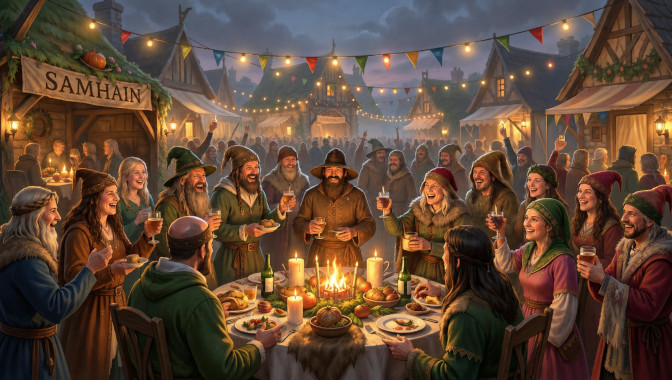
Long before the calendar carried Christian feasts, the Gaelic peoples of Ireland, Scotland and related regions marked a major seasonal turning point called Samhain (pronouced “sow-in” or “sah-win”). The name means “summer’s end.” It signalled the close of the harvest, the bringing in of livestock, and the onset of the dark half of the year.
This was a liminal time — a threshold. Later folklore associated it with the thinning of boundaries between the everyday world and the otherworld of spirits, fairies and the sidhe. Bonfires were lit. People gathered. The season itself felt charged.
Historians caution against over-claiming. We do not have detailed ancient ritual manuals. Much of what is popularly said about Samhain as a straightforward “festival of the dead” was shaped by later Christian observance and by romantic nineteenth-century scholarship. Still, the seasonal power of the date is undeniable. Winter was coming. Death, in the agricultural sense, was in the air. That atmosphere proved sticky.
How the Pieces Fused
In Ireland and Scotland the Christian calendar and older seasonal customs lived side by side and gradually mixed. Two practices in particular matter for the Halloween we recognise today.
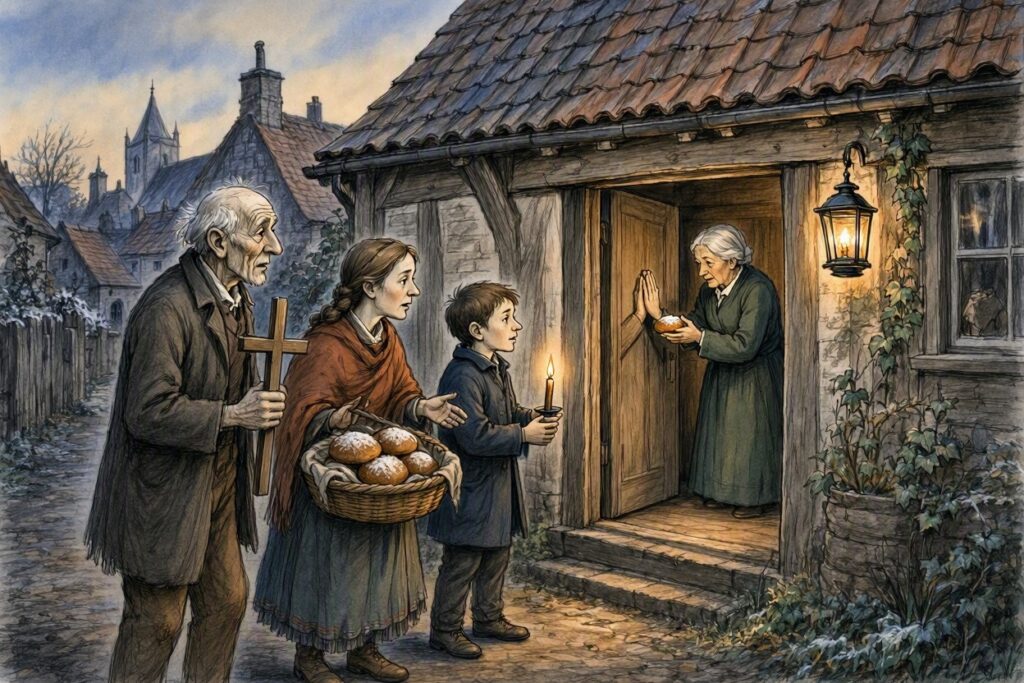
Souling involved the poor going from house to house on the days around All Saints’ and All Souls’, offering prayers for the dead in exchange for “soul cakes.” Guising (or mumming) saw people dressing up and performing songs, verses or tricks for food or coins. Both contained the seeds of door-to-door visiting in costume.
Turnip Lanterns
People also carved lanterns from turnips or similar root vegetables and set them out with lights inside. Pranks and games of divination — especially those involving apples — were common. The night carried a charge of mischief, prophecy and uneasy humour about the dead.
Across the Atlantic
Irish and Scottish immigrants carried these customs to North America in the nineteenth century, especially after the ‘Great Famine’, or as the Irish refer to it: ‘An Gorta Mor’. In the New World the turnip lantern met the pumpkin — larger, easier to carve, and already abundant. The immigrant practices took root and began to change.
By the early twentieth century, Halloween in many American towns had become a night of escalating pranks that sometimes tipped into real vandalism. Communities responded by organising parties and structured visiting. The phrase “trick or treat” appears in North American print in the early decades of the century and became widespread after the Second World War.
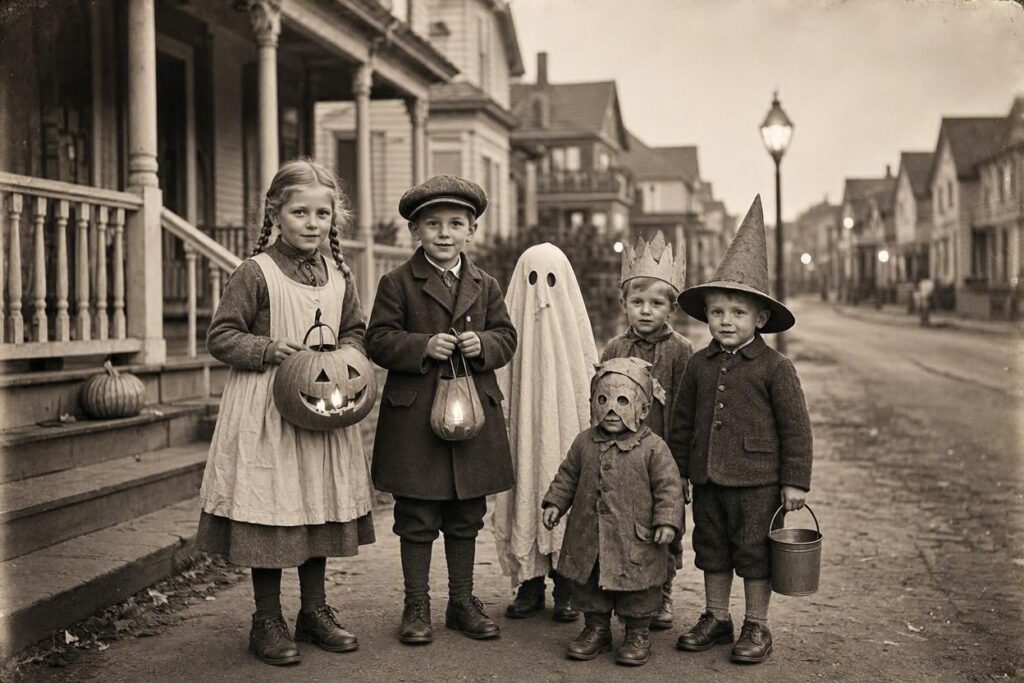
Candy companies, costume makers and, later, Hollywood horror all accelerated the transformation. What had been a regional folk observance with Christian and seasonal roots became a national (and then international) commercial festival of costumes, sugar and controlled fright.
Origin of The Jack O’-Lantern
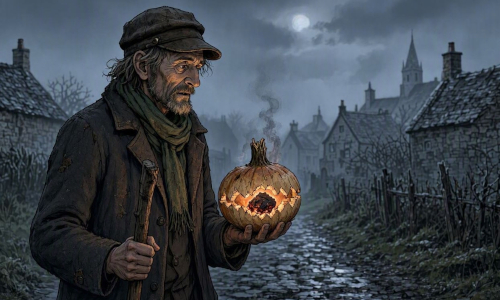
The Jack-o’-lantern has a proper origin story. Irish folklore tells of Stingy Jack, a cunning drunk who twice outwits the Devil — once by trapping him in the form of a coin next to a cross, once by trapping him in an apple tree ringed with carved crosses. When Jack finally dies, Heaven refuses him for his wickedness and Hell refuses him because of the bargains he forced. The Devil gives him a single glowing coal from the fires of Hell to light his way. Jack hollows out a turnip, places the coal inside, and has wandered the earth ever since. Immigrants swapped the turnip for the pumpkin. The name “Jack O’lantern” stuck.
Costumes and Trick or Treat
Costumes and door-to-door visiting did not spring fully formed from ancient spirit-disguises. They grew out of the mixture of guising, souling and later American social engineering that turned destructive mischief into a more manageable (and commercially useful) ritual.
Halloween was once considered dangerous enough that some places seriously discussed banning it. The shift toward organised trick-or-treating and community events was partly a public-order measure.
Why It Still Works — and Why Zombies Belong
At its core, Halloween lets people play with thresholds. It is a night for testing the boundary between the ordinary and the strange, the living and the remembered dead, safety and controlled fear. Costumes let us temporarily become something else. The darkness is invited in, then sent packing with laughter and sugar. This is where the modern figure of the zombie fits with almost unfair perfection.
Zombies are the ultimate liminal beings — denied true death, yet never fully alive.
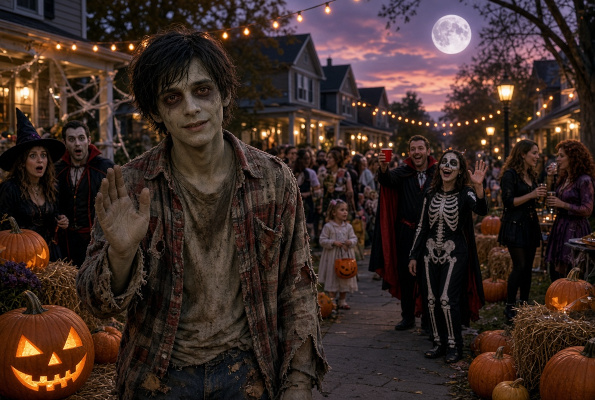
Zombies are the walking embodiment of the thin veil: the dead who refuse to stay on the other side. In that sense the contemporary obsession with the undead is not a random Hollywood invention bolted onto an old holiday. It is a new expression of the same liminal energy that has always hovered around the end of October. The ancient seasonal threshold, the Christian remembrance of the departed, the folk customs of disguise and visitation, and the modern horror imagination all meet in the figure that shambles up the path asking for brains or candy.
Evolution of Halloween
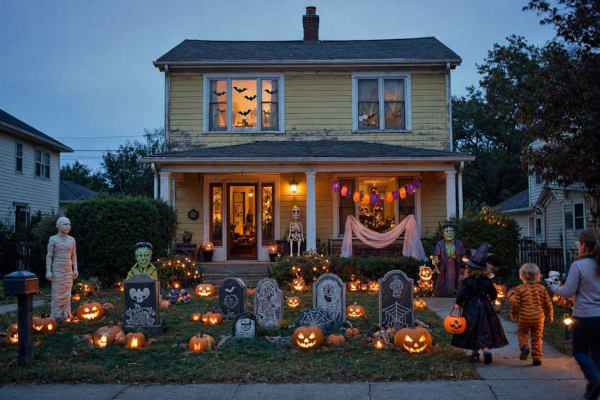
Halloween has survived because it is adaptable. It has absorbed Christian liturgy, Gaelic seasonal feeling, immigrant reinvention, commercial pressure and pop-culture nightmare fuel without losing its essential charge. It remains a night when the ordinary rules feel slightly suspended — when the dead (or at least their stories) feel a little closer, and when it is socially acceptable to dress as something that should not be walking around.
That is the real story. The costumes, the pumpkins and the walking dead are not decorations on top of it. They are the latest, and still evolving, language the holiday uses to speak.
Now that you know a little more of how we got here, enjoy the night. If you want a hand with costumes, Halloween makeup, decorations, or music to set the scene, Zombie Pit is full of ideas.
Irish folk musician Aidan Bolger tells the Stingy Jack story in song, with shadow-play animation. Enjoy!